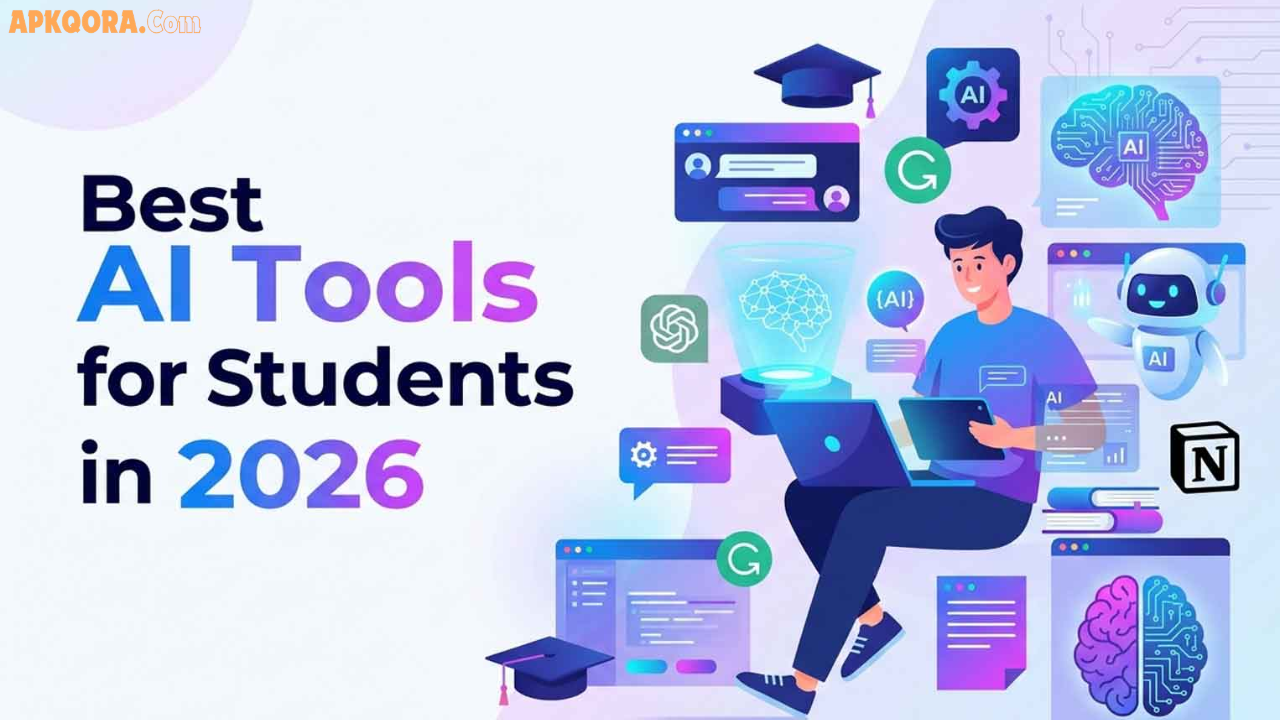

Struggling to keep up with deadlines, research papers, and long reading lists? You are not alone. Millions of students and researchers around the world face the same challenge every day. The good news is that artificial intelligence has changed the way we learn, write, and do research.
In this guide, you will discover the best AI tools for students and researchers right now — tools that are free or affordable, easy to use, and genuinely helpful for academic work.
What Are AI Tools for Students and Researchers?
AI tools for students are smart software applications that use artificial intelligence to help with academic tasks. These include writing assistance, research support, note-taking, math problem solving, grammar checking, and literature review.
These tools range from all-in-one chat assistants like ChatGPT and Claude, to writing aids like Grammarly and QuillBot, math solvers like Wolfram Alpha and Photomath, and productivity tools like Otter.ai for lecture transcription.
The best part? Most of them offer free plans that are more than enough for everyday student use.
Why Students and Researchers Need AI Tools in 2026
Academic life is more demanding than ever. Every year, millions of academic papers are published across thousands of journals, making it increasingly difficult to keep up with the growing volume of knowledge.
AI tools help by automating the repetitive parts — like summarizing long papers, organizing notes, or checking grammar — so you can focus on the thinking and learning that actually matters.
Smart use of AI is not about letting a tool do your work for you. It is about knowing when to rely on technology and when to rely on your own critical thinking.
Best AI Tools for Students and Researchers Right Now
1. ChatGPT — Best All-Rounder for Students
ChatGPT is the most popular AI tool for students worldwide. Students can use it to explain difficult topics in simple words, create summaries, generate study questions, and improve writing. It is the easiest starting point for most students because it is flexible and beginner-friendly.
A smart way to use ChatGPT is as a learning assistant, not as a shortcut for assignments.
Best for: Essay drafting, concept explanation, brainstorming, code help Pricing: Free plan available | Plus at $20/month
2. Perplexity AI — Best for Research with Citations
Perplexity AI is an AI-powered search engine that answers questions with inline citations from verified sources, making it the strongest free research tool for students in 2026. Traditional search buries you in ads and links. Perplexity gives you the answer directly with sources attached.
This makes it extremely useful when you need to verify facts or find sources for your assignments quickly.
Best for: Quick research, source verification, academic queries Pricing: Free plan available | Education Pro at $10/month
3. Consensus — Best for Academic Paper Research
Consensus is indispensable for evidence-based research — it searches over 200 million academic papers with AI-powered synthesis. Instead of browsing multiple journals manually, you can ask a research question and get a summarized answer with real paper citations.
Best for: Literature review, evidence-based research, PhD work Pricing: Free plan available | Paid plans from $10/month
4. Elicit — Best for Literature Reviews
Elicit automates literature review tasks like summarizing papers, extracting data, and identifying key findings. It is perfect for empirical scientific research.
For systematic literature reviews, nothing else comes close. The time savings are measured in weeks, not hours.
Best for: PhD students, systematic reviews, data extraction from papers Pricing: Free (5,000 credits) | Plus at $10/month
5. Grammarly — Best Writing Assistant
Grammarly is a must-have tool for any student who writes essays, reports, or emails. It uses a powerful AI algorithm to offer real-time suggestions for improving grammar, spelling, and writing style. It also detects your content tone so you can convey your message in the right emotion.
Best for: Essay editing, grammar checks, academic writing polish Pricing: Free plan available | Premium plans from $12/month
6. NotebookLM — Best for Organizing Research Notes
NotebookLM by Google is quickly becoming a favorite among researchers. It stands out for structured note synthesis and audio overviews, making it ideal for students who need to organize large amounts of study material.
You can upload PDFs, lecture notes, or research papers and ask questions directly from that material.
Best for: Note organization, PDF summarization, personalized study guides Pricing: Free
7. Notion AI — Best for Academic Organization
Notion AI is a strong choice for students who want to organize their academic life in one place. It helps with note-taking, summarizing lecture material, creating study plans, and turning messy notes into a cleaner structure.
Students managing multiple subjects will find it especially useful for keeping everything in one workspace.
Best for: Project management, study planning, notes organization Pricing: Free plan available | Plus at $10/month
8. Wolfram Alpha — Best for STEM Students
Wolfram Alpha is the go-to tool for students studying mathematics, physics, chemistry, or engineering. It handles equations and computational problems that other tools cannot solve accurately.
Simply type in a math problem or formula and get a step-by-step solution with explanation.
Best for: Math, science, engineering, data computation Pricing: Free plan available | Pro from $7.99/month
9. Otter.ai — Best for Lecture Transcription
Missing important points during long lectures is a common problem. Otter.ai handles transcription and meeting summarization automatically Nerdleveltech, so you can focus on listening instead of writing everything down.
It works in real time and creates searchable transcripts you can review later.
Best for: Lecture notes, interview transcription, meeting summaries Pricing: Free plan available | Pro from $16.99/month
10. SciSpace — Best AI Copilot for Research Papers
SciSpace is an AI copilot designed for academic research. It delivers citation-backed explanations, summaries, and answers directly from research papers.
If you upload a research paper and highlight a confusing section, SciSpace will explain it in simple language — a huge help for non-native English speakers reading complex studies.
Best for: Reading research papers, understanding academic content Pricing: Free plan available | Premium from $12/month
Quick Comparison: Which Tool Is Right for You?
| Tool | Best For | Free Plan |
|---|---|---|
| ChatGPT | General study help | ✅ Yes |
| Perplexity AI | Research with sources | ✅ Yes |
| Consensus | Academic paper search | ✅ Yes |
| Elicit | Literature review | ✅ Yes |
| Grammarly | Writing & grammar | ✅ Yes |
| NotebookLM | Note organization | ✅ Yes |
| Notion AI | Study planning | ✅ Yes |
| Wolfram Alpha | Math & science | ✅ Yes |
| Otter.ai | Lecture transcription | ✅ Yes |
| SciSpace | Research paper reading | ✅ Yes |
Pros and Cons of Using AI Tools for Students
Pros:
- Save hours of time on research and writing tasks
- Help understand complex topics in simple language
- Most tools are free or very affordable
- Available 24/7 — no need to wait for office hours
- Support multiple languages and subjects
Cons:
- Over-reliance can reduce critical thinking skills
- Some tools may produce inaccurate information — always verify
- Many advanced features require paid plans
- Academic integrity policies vary — always check your institution’s rules
Practical Tips for Using AI Tools Effectively
The best AI tools for students do not replace critical thinking — they sharpen it. Whether generating research summaries, organizing notes, or refining your writing, these tools help turn chaos into clarity.
Here are some practical tips to get the most from AI tools:
Start with one or two tools. Starting with one or two tools is the smartest choice. This helps students build a real system instead of jumping between too many platforms.
Use free tiers first. Most tools offer generous free plans. Test them before upgrading to any paid plan.
Never skip verification. Always double-check facts and citations from AI tools, especially for academic submissions.
Match the tool to the task. For researchers, Perplexity + Consensus + Elicit is a powerful combination that covers everything from initial exploration to systematic review. For students, ChatGPT + Grammarly covers tutoring and writing improvement. ToolCenter
Respect academic integrity. Use AI to learn and improve — not to submit work that is not yours.
FAQs About AI Tools for Students and Researchers
Q1: Are AI tools safe to use for academic work? Yes, most AI tools are safe to use for research, brainstorming, and writing improvement. However, always follow your school or university’s academic integrity policy before submitting AI-assisted work.
Q2: What is the best free AI tool for student research? Perplexity AI is widely considered the best free research tool for students because it provides direct answers with cited sources, making it easy to verify information.
Q3: Can AI tools help with PhD research? Absolutely. Tools like Elicit, Consensus, and SciSpace are specifically designed for academic and postgraduate research. They help with literature review, paper summarization, and identifying research gaps.
Q4: Do I need to pay for AI tools as a student? Not necessarily. Most leading AI tools offer strong free plans. Paid upgrades are helpful for heavy usage but are not required for most students.
Q5: Which AI tool is best for writing essays? Grammarly is the top choice for editing and improving writing. ChatGPT is helpful for drafting, brainstorming, and restructuring ideas. Using both together gives strong results.
Conclusion
AI tools are no longer just a trend — they are becoming essential for academic success. Whether you are a high school student, a college learner, or a PhD researcher, there is an AI tool that can help you work smarter and study more effectively.
The key is to choose the right tools for your specific needs, start with free plans, and always use AI to support your learning — not replace it.
Explore these tools today and build a study system that works for you. The future of learning is already here.